Blend Door Actuator in Toyota 4runner Goes Out Again
| Toyota 4Runner | |
|---|---|
 2010 Toyota 4Runner SR5 (U.s.) | |
| Overview | |
| Manufacturer | Toyota |
| Also called | Toyota Hilux Surf (Japan, 1983–2009) |
| Production | October 1983 – nowadays |
| Model years | 1984–nowadays (United states) |
| Body and chassis | |
| Class |
|
| Layout |
|
| Chronology | |
| Successor |
|
The Toyota 4Runner is a meaty, afterward a mid-size sport utility vehicle produced past the Japanese manufacturer Toyota and sold throughout the world from 1984 to the present. In Japan, it is known as the Toyota Hilux Surf (Japanese: トヨタ・ハイラックスサーフ, Hepburn: Toyota Hairakkususāfu ) which was withdrawn from the market in 2009. The original 4Runner was a meaty SUV and little more than a Toyota pickup truck with a fiberglass shell over the bed, but the model has since undergone meaning independent development into a cantankerous between a meaty and a mid-size SUV. All 4Runners have been built in Japan at Toyota'south plant in Tahara, Aichi, or at the Hino Motors (a Toyota subsidiary) plant in Hamura.
The name "4Runner" was created by a copywriter named Robert Nathan who was working for the advertising bureau Saatchi & Saatchi. The agency held contests to invent new vehicle names earlier the introduction of new Toyota models. The name 4Runner was created as a play on the term "forerunner," since the sport utility vehicle was the kickoff of its kind for Toyota with an emphasis on its 4x4 adequacy and seating for four.[ citation needed ]
For some markets, the Hilux Surf was replaced in 2005 by the like Fortuner, which is based on the Hilux platform.
As of 2021[update], the 4Runner is sold in the Bahamas, Republic of bolivia, Canada, Chile, Colombia, Costa Rica, El Salvador, Guatemala, Panama, Peru, the Usa and Venezuela.
The 4Runner came in at number five in a 2019 study by iSeeCars.com ranking the longest-lasting vehicles in the US. The 4Runner had 3.9 percent of vehicles over 200,000 miles (320,000 km), according to the study.[1]
Predecessor: Toyota Trekker (N30; 1981–1983) [edit]
| Toyota Trekker (N30) | |
|---|---|
| Overview | |
| Manufacturer |
|
| Production | 1981–1983 |
| Assembly | United States: Forest City, Iowa (Winnebago) |
| Body and chassis | |
| Body fashion | 2-door pickup |
| Related | Toyota Hilux/Pickup (N30) |
| Powertrain | |
| Engine |
|
| Power output | 96–100 hp (72–75 kW; 97–101 PS) |
| Transmission | 5-speed L52 manual |
| Dimensions | |
| Wheelbase | 102.two in (two,595 mm) |
| Length | 170.1 in (4,320 mm) |
| Width | 66.5 in (1,690 mm) |
| Height | 65.9 in (1,675 mm) |
| Curb weight | iii,120 lb (1,415 kg) |
The Trekker was i of the starting time image walk through conversions done to Toyota trucks in the early 1980s. They were similar to the successive 4Runner conversions washed by Toyota, which started production in 1984, but were designed and built by Winnebago Industries with the blessing of Toyota.[two] [3] The Trekker was no longer viable when Toyota started producing the 4Runner in 1984, having in essence acted equally a marketing test vehicle for that vehicle.
The Trekker was produced from early on 1981 through 1983. The Trekkers were all built on the short wheelbase Hilux chassis. All of the Trekkers were classified every bit SR5 by both Winnebago and Toyota, regardless of the actual VIN denotation. Originally there were to be a SR5 and Palatial version of the Trekker, one with vented windows and one without. All 1981 Trekkers had vented canopy windows. Non-vented awning windows were not installed on the Trekker until the 1982 model year. Unvented windows were installed due to leaking issues of a forward facing vent on the 1981 Trekkers canopy windows rather than the equipment level.
Toyota shipped all trucks from Nihon as cab and chassis in order to avoid the 25% assembled truck customs tax. The trucks destined for production equally Trekkers were shipped to the dealership handling the national distribution of the Trekker. From there they went to Winnebago to have the Trekker conversion installed, returned after completion to the dealership for national distribution. Nigh of the Trekker conversions sold went to the west coast of the Us.
The Trekker conversion consisted of a fiberglass tub, bed sides, a non-removable canopy and rear hatch. The kit included a folding rear seat that could be folded forward to lay apartment and add cargo space to the dorsum. There was no tailgate on the Trekkers. The mill Toyota vinyl cab headliner was replaced and matched to the custom rear awning headliner.
About 1500 of the Trekkers were congenital and sold in the The states. An boosted unknown number of Trekker kits, likely less than 200, were shipped to Canada to be installed on Canadian trucks at the dealerships. 20 to 30 of the Trekker kits were sold and shipped to Saudi Arabia for installation.
First generation (N60; 1983) [edit]
| Get-go generation (N60) | |
|---|---|
 | |
| Overview | |
| Also chosen |
|
| Product | October 1983[four] – August 1989 |
| Model years | 1984–1989 (United states) |
| Assembly | Japan: Tahara, Aichi |
| Trunk and chassis | |
| Class | Compact SUV |
| Body style | three-door SUV |
| Related | Toyota Hilux/Pickup (N60) |
| Powertrain | |
| Engine |
|
| Transmission |
|
| Dimensions | |
| Wheelbase | 103.0 in (two,615 mm) |
| Length | 174.half-dozen in (4,435 mm) |
| Width | 66.5 in (one,690 mm) |
| Acme | 66.1 in (1,680 mm) |
| Curb weight | 3,520–iii,760 lb (one,595–i,705 kg) |
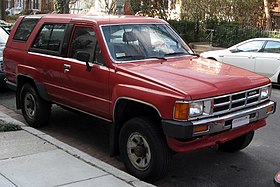
For the first generation N60 series Hilux Surf and consign specification 4Runner introduced in 1983, Toyota, instead of developing an entirely new model, modified the existing Hilux (N50/N60/N70) with brusk-bed pickup torso. The Hilux had undergone a major redesign in 1983 for the 1984 model twelvemonth. Changes included the removal of the console with integrated rear window from behind the front seats, the addition of rear seats, and a removable fiberglass awning. The implementation was borrowed from both the second generation Ford Bronco, and the Chevrolet K5 Blazer, both curt-bed trucks with removable fiberglass shells over the rear sections and having bench seats installed in the dorsum. Like the Bronco and the Blazer, the Hilux Surf/4Runner likewise did not have a wall attached to the front department behind front seats equally the regular Hilux did. In that sense, all three vehicles were more than than merely conventional pickup trucks with a fiberglass crush included.


1987–1989 Toyota 4Runner SR5 (Australia)

1987–1989 Toyota Hilux Surf

1985 Toyota 4Runner with the rear canopy removed
Thus, the first generation is nearly mechanically identical to the Toyota Hilux. All kickoff generation 4Runners had two doors and were indistinguishable from the pickups from the dashboard forward. Well-nigh all changes were to the latter half of the body; in fact, because the rear springs were not upgraded to bear the additional weight from the rear seats and fiberglass elevation, these early models tended to endure from a sagging rear interruption.
In North America, they were sold from the 1984½ model yr from May 1984. For this first twelvemonth (March to July 1984 production), all models were equipped with blackness or white fiberglass tops. An SR5 trim package was offered that upgraded the interior: additional gauges, meliorate fabrics, and a rear seat were standard with the package. All 1984 models were equipped with the carbureted 2.4 L 22R engine and were all available with a iv-wheel-drive system that collection the front wheels through a solid front axle.
1985 (August 1984 production) saw the arrival of the electronically fuel-injected 2.iv Fifty 22R-Eastward (and 22R-EC with California emissions controls) I4 engine. This upped the horsepower numbers from 100 hp for the 22R, to 116 hp for the 22R-E Engine, though the carbureted engine remained available until 1988. Additionally, rear seats were available in all 1985 4Runner trim levels, not just the more upscale SR5.
In 1986, the Surf/4Runner underwent a major front intermission design modify as information technology was changed from a solid front axle to the Hello-Trac contained forepart intermission. Track width was also increased past iii inches. These changes fabricated the trucks more than comfortable on-road, and improved stability and handling. The new suspension also increased the space in the engine compartment (necessary to fit larger engines, such as the V6 introduced in 1987) but arguably decreased the truck's off-road capabilities. The North American specification Toyota Pickup too adopted this new intermission, but the regular Hilux for other markets at this point retained the more rugged and capable, if less refined, solid axle configuration. With the 1986 update, the Surf/4Runner grille changed from the iii segment type to the two segment grille. Tops were colour-matched on bluish, blood-red and some gilded models, while other trunk colors were still sold with black or white tops.
A turbocharged version of the 22R-Eastward engine (the 22R-TE) was also introduced in 1986, although this engine is significantly rarer than the base 22R-Due east. It appears that all turbocharged 4Runner models sold in the U.s. were equipped with an automatic transmission, though a 5-speed manual could still be ordered in the turbocharged pickups. Most turbocharged 4Runners were equipped with the SR5 package, and all turbo trucks had equally standard a heavier rear differential later used in the V6 model. Low-option models had a pocket-sized low-cal in the judge cluster to bespeak turbo heave, while more plush vehicles were equipped with an all-digital gauge cluster that included a boost gauge. Turbocharged and naturally aspirated diesel fuel engines were besides bachelor in the pickups at this time every bit well, just it appears that no diesel-powered 4Runners were imported to the United States.
During 1984 to 1986 many 4Runners were imported to the US without rear seats. With just two seats the vehicle could exist classified as a truck (rather than a sport vehicle) and could skirt the higher customs duties placed upon sport and pleasure vehicles. Most had aftermarket seats and seat belts added past North American dealers after they were imported.
In 1988, the 22R-E engine was joined by an optional 3.0 50 V6 engine, the 3VZ-East. This engine was significantly larger and more powerful although not as reliable as the original four-cylinder offering. Trucks sold with the V6 engine were equipped with the same heavy duty rear differential that was used in the turbocharged trucks, equally well every bit a completely new transmission and transfer case; the transfer case was chain driven, although considered less rugged, created less cab noise than the old gear-driven unit used behind the 4-cylinder engine.
An engine which was not used in the United states of america market and rarely in the Japanese domestic market pickups was the 3Y engine, which was used in place of the 22R engine in New Zealand models, followed more than rarely by the 4Y 2.2 Fifty gasoline in later versions. This was a determination by Toyota New Zealand to reduce parts required to exist stocked by dealers as no other Toyotas sold in New Zealand at the time utilised the R series engines.
Small corrective and choice changes were fabricated in 1988 for the 1989 model year, but the model was left largely untouched in apprehension of the replacement model so undergoing final evolution.
Second generation (N120/N130; 1989) [edit]
| 2nd generation (N120/N130) | |
|---|---|
 | |
| Overview | |
| Also called |
|
| Production | August 1989 – August 1995 |
| Model years | 1990–1995 (US) |
| Associates |
|
| Body and chassis | |
| Class | Compact SUV |
| Body style |
|
| Related | Toyota Hilux/Pickup (N80/N90/N100/N110) |
| Powertrain | |
| Engine |
|
| Transmission |
|
| Dimensions | |
| Wheelbase | 103.3 in (2,625 mm) |
| Length | 176.0–176.8 in (4,470–four,490 mm) |
| Width | 66.five in (i,690 mm) |
| Height | 66.1 in (1,680 mm) |
| Curb weight | three,760 lb (1,705 kg) |

1990–1991 Toyota 4Runner V6 with ii-door bodywork (VZN130; United states of america)

1992–1995 Toyota 4Runner (US; facelift)

1991–1996 Toyota 4Runner (LN130R; Australia)

Toyota Hilux Surf (KZN130G; Japan)
Toyota issued a second generation of Hilux Surf and 4Runner in 1989 for the 1990 model year. Known every bit the N120/N130 series, these models connected their reliance on the Hilux pickup as a basis. It represented a fundamental difference from the offset generation model. Instead of an enhanced pickup truck with fiberglass cap, the new 4Runners featured a freshly designed, full steel integrated torso mounted on the existing frame. However, the 4Runner did remain virtually identical to the Hilux from the B-pillars forward. It also gained an all new roll spring rear suspension system, which unfortunately proved to be just as prone to sagging every bit the leaf springs on the rear of the previous models.
Virtually all 2nd generation 4Runners were four-door models; however, from launch in 1989 to May 1993, a two-door model was also produced. These models are like to the four-door models of the time in that the bodies were formed as a single unit, instead of the fiberglass tops used in the outset generation 4Runners. Two-door cars of the second generation are extremely rare. Usa sales concluded in August 1992, but it continued to be bachelor in the Canadian marketplace through 1993, and Nippon until May 1993.
Because the drive train was even so adult from the same source, the bachelor engines and drivetrains were identical to the corresponding Hilux. The new 4Runner used the contained front suspension that had been developed on the previous generation. The older style gear driven transfer case was phased out on the V6 models and they at present had a chain driven case. The older gear driven case was retained on the iv-cylinder models.
The Hilux Surf version for the Japanese market was as well bachelor with a range of diesel fuel engines, including a two.4 L turbodiesel 2L-TE I4 up to 1993, followed by a iii.0 Fifty turbodiesel 1KZ-TE I4. Small numbers were also made with a normally aspirated 2.8 L diesel 3L I4, a 2.0 L 3Y I4 naturally aspirated gasoline engine, and 2.4 L 22R-E I4 gasoline engine.[v] The majority of gasoline versions of the Hilux Surf received the 3.0 Fifty V6. Various trim levels were offered in Japan ranging from the base model 'SSR' through 'SSR Ltd', 'SSR-5' 'SSR-10' and 'SSR-X Ltd' to the range topping 'SSR-G'.
Nigh other full-body SUVs produced at the time (e.one thousand. Nissan Pathfinder, Ford Explorer) featured tailgates that opened upward with the glass closed. In dissimilarity, the 2nd generation 4Runner carried over the retractable-drinking glass tailgate from the first generation. Opening these tailgates requires offset retracting the rear window into the tailgate and then lowering the tailgate much similar as on a pickup truck.
In 1991 for the 1992 model year, the 4Runner received minor cosmetic updates, including jumpsuit front bumpers and modular headlamps instead of the increasingly outdated rectangular sealed beams. This facelift distanced the 4Runner somewhat from the Hilux pickups which did not receive the same corrective changes. At this time a broad-body version was introduced featuring extended bike arch flares along with wider wheels and tires.
Boosted cosmetic changes occurred between 1993 and 1995, the final year of the second generation.
Safety [edit]
The first and second generation 4Runners were both targeted every bit unsafe SUVs. 1980s and early-1990s crash regulations in the United states were non very strict for light trucks, and all early model 4Runners were fitted with doors that offered little protection in the event of a side collision. In most areas, there was little more than two pieces of sail-metal and the window to keep incoming vehicles from impacting passengers. The crash exam rating for the 2d generation 4Runner was one star for the driver'south side in a frontal collision while the passenger side received a 4-star rating. Later on, more strict crash regulations mandated doors that offered as much protection as passenger doors. In the U.s.a., the 1994 and 1995 model years added side-impact beams in the doors.
Airbags for both the driver and passenger were added in 1995 (1996 model yr).
Tertiary generation (N180; 1995) [edit]
| Tertiary generation (N180) | |
|---|---|
 | |
| Overview | |
| Also chosen |
|
| Production | August 1995 – August 2002 |
| Model years | 1996–2002 (US) |
| Assembly | Japan: Tahara, Aichi; Hamura, Tokyo (Hino) |
| Body and chassis | |
| Class | Mid-size SUV |
| Trunk style | five-door SUV |
| Related |
|
| Powertrain | |
| Engine |
|
| Transmission |
|
| Dimensions | |
| Wheelbase | 105.3 in (ii,675 mm) |
| Length | 178.7–183.3 in (4,540–iv,655 mm) |
| Width | 66.5–70.9 in (one,690–1,800 mm) |
| Superlative | 66.5–68.7 in (one,690–one,745 mm) |
| Curb weight | 3,930 lb (1,785 kg) |
Developed under chief Masaaki Ishiko from 1990 to 1995 under the project code 185T, in late 1995 (for the 1996 model yr) a significant redesign of the 4Runner was introduced, with an all-new body shell on an all-new chassis. Though it shared many parts, including engine and transmission, with the new Tacoma, the torso and chassis were unique for the first fourth dimension. Despite moving upmarket with the rest of the mid-size SUV market place, the new 4Runner differentiated itself by retaining the rugged off-road character its competitors were sacrificing for highway comfort.[6]
The 3rd generation 4Runner featured new engines shared with the commencement generation Toyota Tacoma pickup trucks:
- 2.7L 3RZ-Fe I4 replacing the previous 2.4L 22R-E I4; 150 hp (110 kW) max horsepower at 4800 rpm (an increase of 38 hp (28 kW)), and 177 lb⋅ft (240 Due north⋅grand) max torque at 4000 rpm (an increase of 35 lb⋅ft (47 N⋅m));
- 3.4L 5VZ-FE V6 replacing the previous iii.0L 3VZ-E V6; 183 hp (136 kW) horsepower at 4800 rpm (an increase of 33 hp (25 kW)), and 217 lb⋅ft (294 N⋅m) max torque at 3600 rpm (an increase of 37 lb⋅ft (fifty Due north⋅m)).

Original placard describing the performance of the Toyota rear electronic locker in a 1997 Toyota 4Runner


1998–2000 Toyota Hilux Surf Sports Runner (Japan)

2000–2002 Toyota Hilux Surf (Japan)
In 1996, the 4Runner was dropped from sale in the UK, to be replaced by the Toyota Land Cruiser Prado, which was badged as the Toyota Land Cruiser Colorado.
Meaning changes from the 2d generation models include a larger trunk on a longer wheelbase, increased interior infinite, increased cargo space, dual airbags, ABS, lift-up tailgate, coil-spring suspension all around, rack and pinion steering, and aerodynamic profile designed glass headlights. Additionally, Hilux Surf versions immediately moved to xvi-inch wheels and gained a eye differential, enabling the use of 4-wheel drive on hard surfaces without complexity for the offset time. The prior organization was retained to give on-the-wing shifting betwixt rear- and iv-wheel drive as before. The new 4Runner was also available with a manufactory installed selectable electric locker in the rear differential, a first for the 4Runner but available since 1993 in the Toyota Land Cruiser.
The 1997 model year received a few pocket-size updates, including the addition of a color keyed cargo cover.
The 1998 model year remained largely unchanged, save for a few changes in the electronics. More ergonomic switch control panels and a newly designed iv spoke steering wheel, which likewise necessitated a redesign of the airbag system.
For the 1999 model year, there were both major cosmetic and interior enhancements. A new "fat lip" bumper was designed to let for an extended crush zone on the forepart of the frame, as well as new multi-parabola style headlights, projector style fog lamps, and updated side marking lights and forepart turn signals. Vehicles with "Express" and "Highlander" (subsequently called "Sport Edition") trim received color-keyed running boards, forepart and rear bumpers, mud flaps and flares. The ergonomics of the interior was completely changed, moving all the controls to the center of the dash for the rear window, and defrost, it also received a new musical instrument panel with a digital odometer. The Limited trucks as well received a brand-new electronic temp control, and upgraded stereo. The multimatic transmission became bachelor as an choice for 4WD 4Runners for 1999, giving the option of AWD operation.
The 2001 model year received new transparent tail lights and new front grille design. The wheels were as well changed to a five-spoke design rim. Limited models received newly designed v spoke wheels every bit well, however different from SR5 and base model. Also included was a new, sleeker side view mirror pattern. SR5 and base model 4Runners also have redesigned climate control units utilizing 3 knobs and 2 buttons, contrary to the 1999 model's ii sliders and ii knobs. 2001 models were equipped with Vehicle Stability Control standard, and 4WD models came standard with the multimatic transmission. The optional eastward-locker for the rear differential was dropped in 2001.
The 2002 model yr can be distinguished from the rear by their chromed elevator gate outside trim that encompasses the license plate.
Fourth generation (N210; 2002) [edit]
| 4th generation (N210) | |
|---|---|
 | |
| Overview | |
| Also called | Toyota Hilux Surf (Japan) |
| Production | August 2002 – Baronial 2009 |
| Model years | 2003–2009 (U.s.) |
| Assembly | Japan: Tahara, Aichi; Hamura, Tokyo (Hino) |
| Body and chassis | |
| Class | Mid-size SUV |
| Body style | 5-door SUV |
| Related |
|
| Powertrain | |
| Engine |
|
| Transmission |
|
| Dimensions | |
| Wheelbase | 109.eight in (two,790 mm) |
| Length | 189–189.2 in (4,800–four,805 mm) |
| Width | 73.eight–75.2 in (1,875–1,910 mm) |
| Elevation | 68.nine–71.vi in (1,750–1,820 mm) |
| Curb weight | 4,280 lb (i,940 kg) |
The 4th-generation 4Runner incorporated serious changes to the chassis and body of the vehicle, simply was targeted at approximately the same demographics as the third generation. Based on the State Cruiser Prado 120 series, the new 4Runner retained the aforementioned basic exterior styling themes, and was still marketed as a mid-size semi-luxury SUV with off-road capabilities. Available trims were the SR5, Sport Edition, and Limited models. An all-new LEV certified 4.0 L 1GR-FE V6 which produces 245 hp (183 kW) and 282 lb⋅ft (382 Northward⋅m) of torque is standard, but for the first time, a V8 became available, the ULEV certified four.7 L 2UZ-Iron engine which in the US produced 235 hp (175 kW) and 320 lb⋅ft (434 N⋅1000). In 2004, for the 2005 model yr, the addition of VVT-i increased output to 268 hp (200 kW) and 315 lb⋅ft (427 Northward⋅m). Fuel economy is estimated at 17 mpg city, 20 mpg highway for the V6 and 15/19 mpg for the V8. Towing chapters is 5,000 lb (2,300 kg) on V6 models and vii,300 lb (3,300 kg) on RWD V8 models (7000 pounds westward/4WD). The 4Runner beginning entered dealer showrooms in October 2002 for the 2003 model year.[7] Iii trims levels were offered, SR5, Sport Edition, and Limited. When it was first introduced the SR5 and Sport Edition models used gray plastic cladding and bumpers. Sport models also featured a non-functional hood scoop.
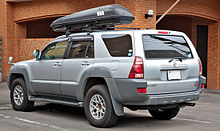
The front end suspension used a double wishbone while the rear is a solid rear axle type. The 4runner continued to use a trunk on frame construction pattern and a solid rear beam for strength and durability compromising interior room and on-route handling. Toyota's other mid-size SUV, the Highlander is a crossover which is not designed for off-roading. The optional 4WD systems were full-time on V8 models while "Multi-Style" or part-time on V6 models, both systems used a lockable Torsen middle differential. A new interruption organization, 10-Relative Absorber System (10-REAS), became standard on the Sport Edition and optional for SR5 and Express models, a rear auto-leveling summit adaptable air interruption is sometimes included with this option on Limited models. The Ten-REAS system links the dampers diagonally past ways of hydraulic hoses and fluid using a mechanical center valve which reduces torso roll during hard cornering. All 4runners were equipped with skid plates for the engine, transfer case, and fuel tank to prevent damage during off-roading. The Colina-Start Assist Control (HAC) system prevents the 4runner from rolling backwards on inclines and a Downhill Aid Command (DAC, 4WD only) modulates the brakes and throttle automatically without driver inputs for polish hill descents at very low speeds, both electronic aids are standard on 4WD models.
Major standard features included a tilt and telescoping steering wheel, remote keyless entry, single zone automatic climate control, power driver's lumbar back up, power rear tailgate window, and on V8 models a tow hitch receiver bolted directly to the rear frame crossmember. Options included HomeLink, an electrochromic motorcar-dimming rearview mirror, power moonroof, third row seating, a DVD-based navigation system (loses in-dash CD changer), a 10-speaker JBL Synthesis stereo, and rear seat sound. An optional backup camera system on Express models used 2 cameras mounted on the interiors D-pillars to give a wider view when backing up. Some trim levels get two mirrors mounted on the interior D-pillars only inside the rear hatch.
In 2009 with the end of this generation, Toyota Nippon ceased production of the Hilux Surf, leaving simply the 4Runner bachelor in the subsequent model serial.
Safety [edit]
All 4Runners came with Toyota'southward Star Safety Organization which includes anti-lock brakes, electronic brakeforce distribution, brake assistance, traction control and Vehicle Stability Command. Side torso airbags for the front rows as well as side curtain airbags for the forepart and rear rows were optional on 2003–2007 models and became standard on 2008 models.
The Insurance Institute for Highway Safety rated the 4Runner as "Good" overall in the frontal offset crash examination, "Expert" overall in the side impact test on vehicles with side airbags, and the 4Runner received a "Poor" rating for rear affect protection.[8] An IIHS report published in Apr 2007 shows the 4Runner has one of the lowest death rates for all vehicles on the route at only thirteen deaths per million registered vehicle years for the 2003 and 2004 model years. Only the Chevrolet Astro, Infiniti G35, and BMW vii series had lower death rates.[9]
| Frontal Driver: |   |
| Frontal Passenger: | |
| Side Driver: | |
| Side Rear Passenger: | |
| Rollover: | |
Yearly changes [edit]
- In early on 2003, Toyota added an optional Appearance Parcel for the SR5 model that included color-keyed cladding, bumpers, and liftgate trim. In Apr 2003, Toyota made the Advent Packet, along with the previously optional fog lamps, running boards, and 16-inch aluminum wheels, standard on the SR5. The Sport Edition as well added black running boards and color-keyed trim, replacing the grey cladding and argent-painted grille, door handles and liftgate trim.[11] [12] [13] [14]
- In late 2003 (for the 2004 model year), a Tire Pressure level Monitoring System was added as standard equipment. A tertiary row seat became optional on the SR5 and Express models.
- In 2004 (for the 2005 model year) enhancements were brought to the optional V8 engine and a 5-speed automatic was fabricated standard on the V6 model. Slight changes were made to the exterior including color-keyed bumper trim (replacing the argent painted trim on all colors except Dorado Gold) on the SR5 and Express; a chrome grille on the SR5; a black roof-rack and running boards (replacing silvery) on the Express; and a redesigned rear spoiler. A Salsa Red Pearl scheme was also introduced for all trim levels, although a similar color scheme was available for tertiary generation models.

Facelifted 4Runner SR5 4WD (Usa)
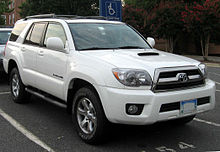
Facelifted 4Runner Sport Edition 4WD (The states)
- 2005 (for the 2006 model year) marked the quaternary generation's mid-cycle refresh. The changes included revised front and rear bumpers; a reworked grille; new projector-beam headlamps and LED tail lamps; additional chrome trim on the SR5 model; and a smoked-chrome grille with tubular roof-rack and step bars on the Sport Edition. The revised forepart bumper features circular fog lights and a relocation of the turn-signals to the headlamp assembly. The redesigned bumper eliminates the rear bumper reflectors. MP3 playback capability and an auxiliary input jack were added to all audio systems. In addition, the Express model was farther differentiated from the other trim levels with the addition of unique xviii" wheels and a seat memory organization. Shadow Mica was added as a color choice. Late in this period, the 1GR-FE V6 engine received a modification to let for an improved head gasket pattern which resolved a common head gasket failure.
- In 2006 (for the 2007 model yr), the 4Runner remained unchanged.
- In 2007 (for the 2008 model year), the 4Runner received standard rollover sensing side drapery airbags and front end row side torso airbags, a switch to disable Vehicle Stability Control, slightly modified front end grille pattern, refinements in the Tire Pressure Monitoring System, and some changes in the seatbelt warning system and brake system control. An Urban Runner Package was also available on the Sport Edition V6 4x4, which added an in dash Tom Tom navigation system, Alcantara inserts in both the front and dorsum seats with dark leather bolstering, the 18" Limited style wheels, a color-keyed front end grill and a double-decker cargo system.
- In 2008 (for the 2009 model year) the 4Runner remained unchanged. A Trail Edition package offered an electronic locking rear differential, a switch to enable/disable Advanced Traction Control (A-TRAC) and Bilstein dampers.
Later models offered a DVD Rear Seat Entertainment System (RSES) which used a 9-inch LCD screen and 2 wireless headphones.
Fifth generation (N280; 2009) [edit]
| Fifth generation (N280) | |
|---|---|
 | |
| Overview | |
| Production | August 2009 – present |
| Model years | 2010–nowadays (U.s.) |
| Assembly | Nippon: Tahara, Aichi (Tahara plant)[15] |
| Designer |
|
| Body and chassis | |
| Class | Mid-size SUV |
| Trunk manner | 5-door SUV |
| Related |
|
| Powertrain | |
| Engine |
|
| Transmission |
|
| Dimensions | |
| Wheelbase | 109.8 in (2,790 mm) |
| Length | 189.9–191.3 in (4,825–4,860 mm) |
| Width | 75.eight in (1,925 mm) |
| Height | 70.7 in (one,795 mm) |
| Curb weight | 4,400–four,805 lb (1,995–2,180 kg) |
The 5th-generation 4Runner was unveiled at the Land Fair of Texas on September 24, 2009. It is congenital on the same platform as the FJ Cruiser, J150 series Land Cruiser Prado and Lexus GX.[18] Initially, it is available in 3 trim levels, 2 of which were available previously. The base SR5 trim too as the top-of-the-line Limited trim are available every bit a 2WD or a 4WD. The Trail Edition is only available equally a 4WD. The SR5 and Trail Edition 4WDs received a part-time 4WD drive system, while the Limited has full-time 4WD. All models came with Active Traction Command (A-TRAC).[19] The new Trail Edition offers Toyota'southward Kinetic Dynamic Suspension Arrangement (KDSS) and Clamber Command which had previously only been bachelor to premium Toyota vehicles, likewise every bit a rear locking differential similar the previous Trail Package.
Product started on 31 August 2009.[ citation needed ] Despite being built in Japan, it was only produced in left-hand bulldoze and it was not sold at that place or whatever other RHD markets.
The 4.0-liter V6 adds Dual VVT-i which improves horsepower, torque and fuel economy, and comes standard in all models. A two.7-liter I4 was available on 2WD models, but was discontinued later on the 2010 model year. The 4.7-liter V8 from the previous generation was not carried over to the 5th generation 4Runner.[20]
Model year changes [edit]
In 2013 (for the 2014 model twelvemonth), the 4Runner received a facelift, consisting of revised front and rear fascia with projector headlamps and clear-lensed, LED tail-lamps, as well as other minor exterior cosmetic changes. The interior was besides updated, with soft-bear upon door trim, leather-wrapped steering wheel and shift knob, revised dashboard and center stack, and the inclusion of Toyota'southward Optitron instrument cluster as standard across all trim levels. Brake lines were upgraded for improved pedal feel, and electronic Trailer Sway Control programming included. No driveline changes were made. All 2014 model year 4Runner models are powered by a 4.0-liter Five-six engine with intelligent Variable Valve Timing (VVT-i) that tin can develop 201 kW (270 bhp) and 377 Northward⋅m (278 ft⋅lb) of torque. It is mated to a five-speed automated ECT transmission.[21]
In 2014 (for the 2015 model year) the TRD Pro trim level was introduced in the Usa, with Toyota badging on the forepart as well equally an off-road package as office of the TRD Pro Series. The TRD Pro 4Runner included TRD Bilstein shocks with remote reservoirs, TRD-tuned front end springs and TRD front skid plate.[22] For each model twelvemonth of the TRD Pro, beyond the 2 colors available on all trims, the TRD Pro is available in an exclusive color. This was 'Inferno Orangish' for the 2015 model year,[23] 'Quicksand' for 2016, 'Cement' for 2017, 'Cavalry Blue' for 2018, 'Voodoo Blue' for 2019, 'Ground forces Green' for 2020, 'Lunar Rock' for 2021, and 'Lime Rush' for 2022. All United States models received the Entune touchscreen infotainment system with a 6.1-inch display and a rear backup camera equally standard equipment, with optional GPS navigation, SiriusXM Satellite Radio, HD Radio, and Safety Connect. Merely the Limited model featured a standard JBL premium amplified audio system.[ commendation needed ]
In 2016 (for the 2017 model year), the 4Runner Trail and Trail Premium were renamed to TRD Off-Road and TRD Off-Road Premium in the Us. These trim levels share the same mechanical functionality of the one-time Trail edition, just add aesthetic differences and TRD badging to differentiate themselves from the base of operations model. They do non share the same interruption equally the TRD Pro model.[24]
In 2018 (for the 2019 model twelvemonth), Toyota began offering a 'Nightshade' package based on the Express trim which blacks out badging, lower front end and rear fascia, wheels, and portions of the interior.[25]
In 2019 (for the 2020 model yr), Toyota appear that all 4Runner trims will receive Toyota Safety Sense-P (TSS-P) standard as well every bit two additional rear seat USB ports. The TRD Pro volition accept an updated grille design to suit the front radar sensor for TSS-P.[26] All The states models received an updated Entune iii.0 infotainment organisation with a larger, higher-resolution touchscreen display, Apple CarPlay and Android Machine smartphone integration and Amazon Alexa integration, 4G LTE internet access powered past Verizon Wireless, Safety Connect, and standard SiriusXM Satellite Radio and optional HD Radio. The TRD Pro model receives a JBL premium amplified audio arrangement as standard equipment. The system was previously only available on Express models, where it remains standard equipment. Nigh models also characteristic standard GPS navigation.[ citation needed ]
In 2021 (for the 2022 model yr), Toyota included their smart key organization with push push button as standard for all trims. The new TRD Sport trim was besides added into the lineup. The TRD Sport received the same bumper, 20" wheels and the X-REAS suspension from the Limited. It also includes TRD parts such every bit the TRD shifter, TRD hood with scoop, TRD badges, and Softex seats with TRD lettering. Different the Limited, it is available only with 2WD or role-time 4WD. Toyota added LED foglights, lowbeams and highbeam headlights equally standard for all trims for the first time. Blind spot monitor and rear cross traffic alert were added as standard for virtually trims. The TRD Pro now gets standard multi-terrain monitor. Using strategically placed cameras, the system lets the driver bank check environs on the trail, with the ability to spot potential obstacles not easily seen from the cabin. The Express trim adds a standard Panoramic View Monitor, which is similar to the multi-terrain monitor on the TRD Pro. The Limited course and TRD models also add together a premium Multi-Information Display. All trims receives rear occupancy alert as standard. Lime Blitz is the new exclusive paint for the 2022 model year TRD Pro.[27]
-

Toyota 4Runner SR5, rear view
-

2014 4Runner Limited (GRN280L)
-
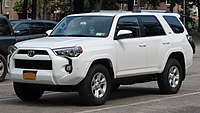
2019 4Runner SR5 (GRN280L)
-

2019 4Runner SR5 (GRN280L)
-

2020 4Runner TRD Pro
-

2022 Toyota 4Runner TRD Pro in Lime Blitz, rear view
Condom [edit]
| Category | Rating |
|---|---|
| Moderate overlap frontal offset | Good |
| Pocket-sized overlap frontal offset (2014–nowadays) | Marginalone |
| Side bear on | Good |
| Roof forcefulness | Goodii |
- 1 vehicle construction rated "Poor"
- 2 strength-to-weight ratio: 4.11
Sales [edit]

| Calendar year | US |
|---|---|
| 1984 | 6,498 |
| 1985 | five,495 |
| 1986 | five,564 |
| 1987 | three,635 |
| 1988 | twenty,880 |
| 1989 | 36,927 |
| 1990 | 48,295 |
| 1991 | 44,879 |
| 1992 | 39,917 |
| 1993 | 46,652 |
| 1994 | 74,109 |
| 1995 | 75,962 |
| 1996 | 99,597 |
| 1997 | 128,496 |
| 1998 | 118,484 |
| 1999 | 124,221 |
| 2000 | 111,797[29] |
| 2001 | 90,250[29] |
| 2002 | 77,026[xxx] |
| 2003 | 109,308 |
| 2004 | 114,212 |
| 2005 | 103,830 |
| 2006 | 103,086[31] |
| 2007 | 87,718[32] |
| 2008 | 47,878 |
| 2009 | 19,675[33] |
| 2010 | 46,531[33] |
| 2011 | 44,316[34] |
| 2012 | 48,755[34] |
| 2013 | 51,625[35] |
| 2014 | 76,906[36] |
| 2015 | 97,034[37] |
| 2016 | 111,970[38] |
| 2017 | 128,296[39] |
| 2018 | 139,694[40] |
| 2019 | 131,864[41] |
| 2020 | 129,052[42] |
| 2021 | 144,696[43] |
References [edit]
- ^ Blackley, Julie (2019-03-03). "Longest Lasting Cars to Reach 200,000 Miles – 2019 Report Shows Full-Size SUVS Dominate". iSeeCars.com. Retrieved 2019-03-14 .
- ^ "History". toyotatrekker.com. 2010-07-01. Retrieved 2016-03-29 .
- ^ Saunders, David (2014-06-22). "Cars of a Lifetime: 1989 Toyota Hilux SURF (4Runner) – A Walk On The Correct-Hand Drive Side". Curbside Classics. Retrieved 2014-07-03 .
- ^ "75 Years of Toyota | Vehicle Lineage". Toyota. 2012. Retrieved 2018-07-24 .
- ^ Büschi, Hans U., ed. (March 1991). Automobil Revue 1991. Vol. 86. Berne, Switzerland: Hallwag AG. pp. 587–588. ISBN3-444-00514-8.
- ^ "New 4runner Every bit Rugged As Ever". Orlando Lookout. U.s.. 1995-12-28. Retrieved 2017-02-twenty .
- ^ Roca, Carrie. "2003 Toyota 4Runner". Autoweek.com. Archived from the original on 2011-06-28. Retrieved 2009-12-12 .
- ^ "IIHS-HLDI: Toyota 4Runner". Iihs.org. Retrieved 2016-01-24 .
- ^ "Status Report, Vol. 42, No. 4, Apr nineteen, 2007" (PDF). Archived from the original (PDF) on 2014-01-17. Retrieved 2009-12-12 .
- ^ "Safercar.gov". Safercar.gov. Retrieved 2009-12-12 . [ dead link ]
- ^ "Toyota 4Runner Road Examination". Familycar.com. Archived from the original on 2013-01-10. Retrieved 2009-12-12 .
- ^ "Start Drive: 2003 Toyota 4Runner". CanadianDriver. 2002-09-thirty. Retrieved 2009-12-12 .
- ^ "Full Exam: 2003 Toyota 4Runner Express". Edmunds.com. 2003-01-03. Archived from the original on 2009-02-28. Retrieved 2009-12-12 .
- ^ "First Drive: 2003 Toyota 4Runner". Edmunds.com. 2002-09-xvi. Archived from the original on 2008-12-10. Retrieved 2009-12-12 .
- ^ "Japanese Product Sites". Toyota. 2015-03-06. Archived from the original on 2015-03-18.
- ^ USD605559S1, Iwasaki, Ken & Matsumoto, Tom, "Motorcar and toy replica thereof", issued 2009-12-08
- ^ "Car and/or toy replica thereof: Us D710253 S1". Retrieved 2016-09-16 – via Google Patents.
- ^ "2012 Toyota 4Runner". TechXreview.com. Archived from the original on 2012-06-21. Retrieved 2012-06-xiii .
- ^ "ebrochure for United states 2010 model year". 2009. Archived from the original (PDF) on 2009-10-01. Retrieved 2009-09-26 .
- ^ "2010 Toyota 4Runner Officially Revealed [Video]". Worldcarfans.com. Retrieved 2009-12-12 .
- ^ "2014 Toyota 4Runner Review". 2015carreviews.com. 2014-03-14. Retrieved 2014-03-16 .
- ^ Sandhu, Bobby (2014-02-20). "Toyota 4Runner TRD Pro Series 2015". thecarwallpapers.com. Retrieved 2014-02-21 .
- ^ "2015 Toyota 4Runner Product Data" (Press release). USA: Toyota. 2014-12-02. Retrieved 2017-01-06 .
- ^ "Making the Grade: 2017 4Runner TRD Off-Road Joins TRD Line-Up" (Printing release). United states: Toyota. 2016-07-21. Retrieved 2016-08-16 .
- ^ "2019 Toyota 4Runner Strengthens Legacy in 35th Year" (Press release). Us: Toyota. 2018-x-17. Retrieved 2019-02-08 .
- ^ "2020 Toyota Sequoia TRD Pro Opens Path to Family Adventures, Leads Charge for Updates on all TRD Pro Models" (Press release). USA: Toyota. 2019-02-07. Retrieved 2019-02-08 .
- ^ "2022 Toyota 4Runner Adds New TRD Sport Model, New Standard Safe Features" (Press release). U.s.a.: Toyota. 2021-09-01. Retrieved 2021-09-01 .
- ^ "2015 Toyota 4Runner Midsize SUV". IIHS. Retrieved 30 September 2015.
- ^ a b "Toyota Sets Sales Record for Sixth Year in a Row". Theautochannel.com. Retrieved 2009-12-12 .
- ^ "Toyota Announces Best Sales Yr in Its 46-Year History, Breaks Sales Record for Eighth Year in a Row". Theautochannel.com. Retrieved 2009-12-12 .
- ^ "Toyota Sales December 2007" (Press release). USA: Toyota. Retrieved 2017-05-16 .
- ^ "Toyota Sales December 2007" (Press release). USA: Toyota. Retrieved 2017-05-sixteen .
- ^ a b "Toyota Sales December 2010" (PDF) (Press release). U.s.a.: Toyota. Archived from the original (PDF) on 2012-09-05. Retrieved 2013-01-01 .
- ^ a b "December 2012 and Year-End Sales Chart" (Press release). USA: Toyota. 2013-01-03. Archived from the original on 2013-01-06. Retrieved 2013-01-04 .
- ^ "December 2013 and Year-Terminate Sales Chart" (Press release). USA: Toyota. 2014-01-03. Archived from the original on 2014-01-08. Retrieved 2014-01-09 .
- ^ "December 2014 and Year-End Sales Nautical chart" (Printing release). USA: Toyota. 2015-01-05. Archived from the original on 2015-01-07. Retrieved 2015-01-06 .
- ^ "December 2015 and Year-Finish Sales Chart" (Press release). U.s.a.: Toyota. 2016-01-05. Archived from the original on 2016-01-18. Retrieved 2016-01-18 .
- ^ "December 2016 and Year-Terminate Sales Chart" (Printing release). USA: Toyota. 2017-01-05. Retrieved 2017-01-05 .
- ^ "December 2017 Sales Chart" (Press release). U.s.a.: Toyota. 2018-01-03. Archived from the original on 2018-07-18. Retrieved 2018-02-x .
- ^ "Toyota Motor North America Reports Dec 2018, Year-End Sales" (Press release). USA: Toyota. 2019-01-03. Archived from the original on 2019-02-04. Retrieved 2019-01-04 .
- ^ "Toyota Motor North America Reports December 2019, Year-End Sales" (Press release). USA: Toyota. 2020-01-03.
- ^ "Toyota Motor Due north America Reports December 2020, Yr-End Sales" (Press release). U.s.: Toyota. 2021-01-05.
- ^ "Toyota Motor N America Reports December 2021, Yr-Cease Sales" (Printing release). Usa: Toyota. 2022-01-04.
External links [edit]
- Official website (US)
Source: https://en.wikipedia.org/wiki/Toyota_4Runner
0 Response to "Blend Door Actuator in Toyota 4runner Goes Out Again"
Post a Comment