what type of evidence tends to prove or disprove a fact in question?
Chief Body
Chapter iii: What You lot Need To Know About Evidence
"Evidence forms the building blocks of the investigative procedure and for the final product to be built properly, evidence must exist recognized, collected, documented, protected, validated, analyzed, disclosed, and presented in a way which is adequate to the court."
The term "evidence," equally it relates to investigation, speaks to a wide range of information sources that might somewhen inform the courtroom to prove or disprove points at outcome earlier the trier of fact. Sources of evidence can include annihilation from the observations of witnesses to the exam and analysis of physical objects. It can fifty-fifty include the spatial relationships betwixt people, places, and objects within the timeline of events. From the diverse forms of evidence, the court tin can depict inferences and achieve conclusions to determine if a charge has been proven beyond a reasonable doubt.
Considering the critical nature of prove within the court system, there are a wide variety of definitions and protocols that have evolved to straight the way show is defined for consideration by the courtroom. Many of these protocols are specifically addressed and defined inside the provisions of the Canada Evidence Act (Government of Canada, 2017).
In this chapter, we will look at some of the key definitions and protocols that an investigator should understand to bear out the investigative procedure:
- The probative value of prove
- Relevant evidence
- Directly evidence
- Circumstantial evidence
- Inculpatory evidence
- Exculpatory evidence
- Corroborative evidence
- Disclosure of evidence
- Witness evidence
- Hearsay show
- Search and seizure of evidence
- Exclusion of evidence
Topic 1: The Probative Value of Prove
Each piece of relevant evidence will exist considered based on its "probative value," which is the weight or persuasive value that the court assigns to that particular slice of show when considering its value towards proving a point of fact in question for the case beingness heard. This probative value of prove goes towards the judge, or the gauge and jury, reaching their decision of proof beyond a reasonable uncertainty in criminal court, or proof within a balance of probabilities in ceremonious court.
Eye Witness Evidence
A competent, compellable, independent, heart witness with excellent concrete and mental capabilities, who has seen the criminal event have identify and can recount the facts will generally satisfy the courtroom and provide prove that has high probative value. In assessing the probative value of witness evidence, the court will consider several factors that we will discuss in more item in our chapter on witness management. These include:
- The witness blazon as either middle witness or corroborative witness
- The witness competency to prove
- The witness compellability to testify
- The level of witness independence from the event
- The witness credibility based on assessment of physical limitations
Physical Evidence
The court will also generally attribute a high probative value to physical exhibits. The courtroom likes physical evidence because they are items the courtroom can run across and examine to interpret the facts in effect for proof beyond a reasonable doubt. Physical testify can include only about anything, such as weapons, fingerprints, shoe prints, tire marks, tool impression, hair, fibre, or trunk fluids. These kinds of concrete exhibits of evidence tin can be examined and analyzed past experts who tin can provide the court with expert opinions that connect the detail of evidence to a person, identify, or the criminal effect. This allows the courtroom to consider coexisting connections of the accused to the crime scene or the accused to the victim. For example, in the case where the fingerprints of a suspect are found at a crime scene, and a Dna match of a murder victim's blood is plant on that suspect's clothing, forensic connections could be made and, in the absence of an explanation, the court would probable detect this physical bear witness to exist relevant and compelling prove with high probative value.
Topic ii: Relevant Evidence
Relevant testify speaks to an effect before court in relation to the accuse being heard. Relevant evidence includes both direct show and indirect circumstantial evidence. For either direct or indirect circumstantial evidence to be considered relevant to the court, information technology must relate to the elements of the offence that demand to be proven. If the show does not relate to proving the place, fourth dimension, identity of the accused, or criminal acts within the offence itself, the show will non be considered relevant to the charge. The prosecution may present testify in the form of a physical exhibit that the court can see and examine to consider, or they may present prove in the grade of witness testimony, in which case the witness is telling the court what they perceived inside the limits of their senses.
Topic iii: Direct Evidence
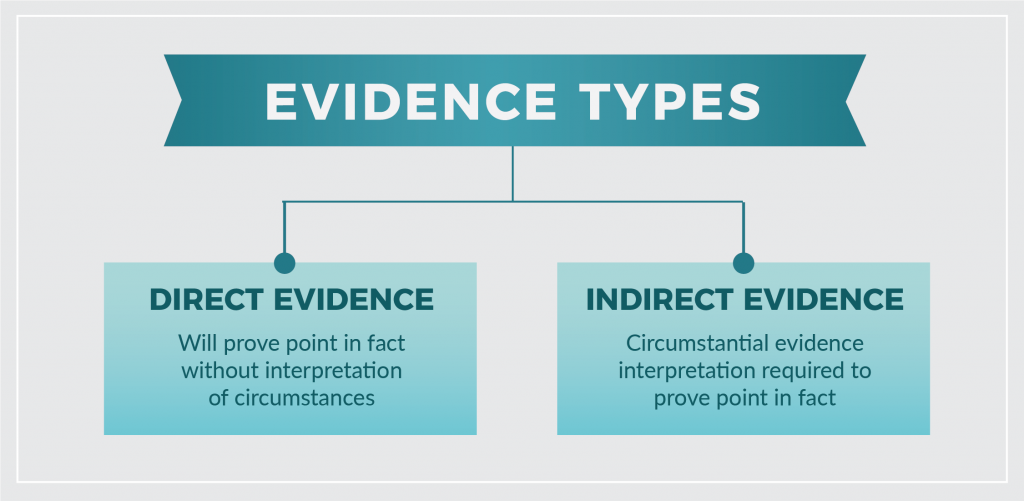
Direct bear witness is testify that will prove the point in fact without estimation of circumstances. (Justice Department Canada, 2017). It is whatever bear witness that can show the court that something occurred without the demand for the judge to brand inferences or assumptions to reach a conclusion. An eyewitness who saw the accused shoot a victim would be able to provide direct evidence. Similarly, a security camera showing the defendant committing a crime or a argument of confession from the defendant admitting to the criminal offence could also exist considered directly prove. Directly evidence should non exist confused with the concept of straight examination, which is the initial exam and questioning of a witness at trial by the party who called that witness. And, although each witness who provides bear witness could, in theory, exist providing direct testimony of their own knowledge and experiences, that testify is oftentimes non direct prove of the offence itself.
Topic 4: Coexisting Prove
Indirect evidence, likewise called circumstantial show, is all other evidence, such every bit the fingerprint of an accused found at the criminal offence scene. Indirect prove does non by itself bear witness the offence, but through interpretation of the circumstances and in conjunction with other evidence may contribute to a body of evidence that could bear witness guilt beyond a reasonable doubt (Justice Department Canada, 2017). Strong circumstantial testify that only leads to one logical determination can sometimes become the prove the court uses in reaching belief beyond a reasonable dubiousness to convict an accused. It requires assumptions and logical inferences to exist made by the court to attribute meaning to the testify.
"When ane or more things are proved, from which our feel enables u.s.a. to ascertain that another, not proved, must have happened, we assume that it did happen, as well in criminal as in civil cases" (MacDonell, 1820).
Coexisting bear witness demonstrates the spatial relationships between suspects, victims, timelines, and the criminal outcome. These spatial relationships tin sometimes demonstrate that an defendant person had a combination of intent, motive, opportunity, and/or the means to commit the offence, which are all meaningful features of criminal acquit.
Circumstantial evidence of intent tin can sometimes be shown through indirect evidence of a suspect planning to commit the offence, and/or planning to escape and dispose of prove after the offence. A pre-crime statement about the programme could demonstrate both intent and motive, such as, "I really demand some coin. I'm going to rob that bank tomorrow."
Circumstantial evidence of conflict, vengeance, financial gain from the commission of the offence can also get evidence of motive.
Coexisting evidence of opportunity can be illustrated by showing a doubtable had access to a victim or a crime scene at the fourth dimension of the criminal event, and this access provided opportunity to commit the crime.
Circumstantial evidence of means can sometimes be demonstrated past showing the suspect had the concrete capabilities and/or the tools or weapons to commit the offence.
Presenting this kind of circumstantial bear witness can assist the court in confirming assumptions and inferences to reach conclusions assigning probative value to connections between the defendant and a person or a place and the concrete evidence. These circumstantial connections tin create the essential links between a suspect and the crime.
There are many ways of making linkages to demonstrate coexisting connections. These range from forensic analysis of fingerprints or Dna that connect an accused to the crime scene or victim, to witness evidence describing criminal conduct on the part of an accused earlier, during, or subsequently the offence. The possibilities and variations of when or how coexisting evidence volition emerge are endless. It falls upon the investigator to consider the big picture of all the show and then analytically develop theories of how events may have happened. In one case a reasonable theory has been formed, evidence of coexisting connections can be validated through further investigation and analysis of concrete exhibits to connect a suspect to the law-breaking.
Topic 5: Inculpatory Evidence
Inculpatory testify is whatsoever show that will directly or indirectly link an accused person to the offence being investigated. For an investigator, inculpatory testify can be found in the victim's complaint, physical evidence, witness accounts, or the circumstantial relationships that are examined, analyzed, and recorded during the investigative procedure. Information technology tin be annihilation from the direct testify of an eyewitness who saw the accused committing the criminal offence, to the circumstantial evidence of a fingerprint constitute in a location connecting the accused to the victim or the crime scene.
Naturally, directly bear witness that shows the accused committed the crime is the preferred inculpatory evidence, but, in exercise, this it is frequently non bachelor. The investigator must look for and interpret other sources for testify and information. Often, many pieces of circumstantial evidence are required to build a instance that allows the investigator to achieve reasonable grounds to believe, and enables the court to reach their belief across a reasonable doubt.
A unmarried fingerprint plant on the outside driver's door of a stolen car would non be sufficient for the court to find an accused guilty of motorcar theft. However, if you added witness prove to show that the accused was seen nigh the car at the time it was stolen, and a security photographic camera recording of the accused walking off the parking lot where the stolen car was dumped, and the police finding the accused leaving the dump site where he attempted to toss the keys of that stolen car into the bushes, the court would probable have proof across a reasonable doubt.
If an abundance of inculpatory circumstantial evidence can be located for presentation to the courtroom that leads to a single logical conclusion, the court will ofttimes accomplish their conclusion of proof beyond a reasonable doubt, unless exculpatory bear witness is presented by the defence to create a reasonable doubtfulness.
Topic 6: Exculpatory Show
Exculpatory evidence is the exact reverse of inculpatory evidence in that it tends to show the defendant person or the suspect did non commit the offence. Information technology is important for an investigator to not merely look for inculpatory evidence, but to also consider evidence from an exculpatory perspective. Considering evidence from the exculpatory perspective demonstrates that an investigator is being objective and is non falling into the trap of tunnel vision. If it is possible to find exculpatory evidence that shows the suspect is not responsible for the offence, it is helpful for police because it allows for the elimination of that suspect and the redirecting of the investigation to pursue the existent perpetrator.
Sometimes, exculpatory testify will be presented past the defence at trial to show the defendant was not involved in the offence or maybe only involved to a lesser degree. In our previous circumstantial case of car theft, there is potent circumstantial case; but what if the defence produces the following exculpatory evidence where:
- A tow truck dispatcher testifies at the trial and produces records showing the accused is a tow truck driver;
- On the date of the machine theft, the accused was dispatched to the site of the car theft to assist a motorist locked out of his motorcar;
- The accused testifies that he only assisted another male to gain entry to the stolen car because he could see the motorcar keys on the front end seat;
- The accused explains that, later opening the motorcar, he agreed to meet this male person at the parking lot where the car was left parked;
- He accepted the keys of the stolen auto from the other male to tow the vehicle afterwards to a service station from that location;
- When approached by police, he stated that he became nervous and suspicious about the car he had but towed; and
- He tried to throw the keys away because he has a previous criminal record and knew the police force would not believe him.
Provided with this kind of exculpatory evidence, the court might dismiss the instance confronting the accused.
Having read this, you may exist thinking that this exculpatory evidence and defence sounds a piffling vague, which is the dilemma that often faces the court. If they tin can notice guilt beyond a reasonable doubt, they will convict, but if the defense can present evidence that creates a reasonable uncertainty, they will make a ruling of non guilty. Experienced criminals can be very masterful at coming up with alternate explanations of their involvement in criminal events, and it is sometimes helpful for investigators to consider if the fabrication of an alternate explanation will be possible. If an alternate caption can be predictable, additional investigation tin can sometimes challenge the untrue aspects of the alternating possibilities.
Topic seven: Corroborative Evidence
The term corroborative testify essentially refers to any type of prove that tends to support the meaning, validity, or truthfulness of another piece of bear witness that has already been presented to the court. A piece of corroborative show may have the form of a physical item, such as a Dna sample from an accused matching the Deoxyribonucleic acid institute on a victim, thus corroborating a victim's testimony. Corroborative evidence might also come from the argument of i independent witness providing testimony that matches the business relationship of events described by another witness. If it tin can exist shown that these 2 witnesses were separated and did not collaborate or hear each other'south account, their statements could be accepted by the court as mutually corroborative accounts of the same effect.
The courts assign a dandy deal of probative value to corroborative evidence because information technology assists the courtroom in reaching their conventionalities beyond a reasonable doubt. For investigators, it is important to non only wait for the minimum amount of evidence apparent at the scene of a criminal offence. Investigation must also seek out other evidence that can corroborate the facts attested to past witnesses or victims in their accounts of the event. An interesting case of corroborative bear witness can exist found in the court's acceptance of a police investigators notes as being circumstantially corroborative of that officer'southward evidence and business relationship of the events. When a police investigator testifies in court, they are normally given permission by the courtroom to refer to their notes to refresh their retentiveness and provide a full account of the events. If the investigator's notes are detailed and accurate, the court tin can give significant weight to the officer'southward account of those events. If the notes lack detail or are incomplete on meaning points, the court may assign less value to the accuracy of the investigator'southward business relationship.
For the court, detailed notes properly made at the time corroborate the officer'southward evidence and represent a circumstantial guarantee of trustworthiness for the officer'due south testimony (McRory, 2014).
Topic 8: Disclosure of Prove
It is important for an investigator to be aware that all aspects of their investigation may become discipline to disclosure as potential evidence for court. Every bit part of the process of fundamental justice within the Canadian Lease of Rights and Freedoms, a person charged with an offence has the right to total disclosure of all the evidence of the investigation (R v Stinchcombe, 1991). This means that whatever testify or information gathered during the police investigation must be available for the defense force to review and make up one's mind if that evidence could assist the accused in presenting a defence to the accuse earlier the courtroom.
In the disclosure process, the determination to disclose or not to disembalm is the exclusive domain of the crown prosecutor and, although police investigators may submit data and evidence to the prosecutor with the request that the data exist considered an exception to the disclosure rules, the terminal decision is that of the crown. That said, fifty-fifty the conclusion of the crown may exist challenged past the defense and that then becomes a final determination for the Guess. The prosecutor will ask the constabulary to provide a full disclosure of the bear witness gathered during their investigation.
The list of what should course role of a normal disclosure will typically include:
- Charging document
- Particulars of the offence
- Witness statements
- Audio/video evidence statements by witnesses
- Statements by the defendant
- Defendant's criminal tape
- Expert witness reports
- Notebooks and Police force reports
- Exhibits
- Search warrants
- Authorizations to intercept private communications
- Like fact evidence
- Identification evidence
- Witnesses' criminal records
- Reports to Crown Counsel recommending charges
- Witness impeachment fabric
It is worth stressing that police force notes and reports relating to the investigation are typically studied very carefully by the defence to ensure they are consummate and have been completely disclosed. Disclosure will as well include investigation notes and reports that relate to alternate persons considered, investigated, and eliminated as suspects in the offense for which the accused is existence tried. If alternate suspects were identified and not eliminated during the investigation, that lack of investigation may form the footing for a defence to the charge.
The issues relating to the disclosure of prove have been the subject field of several Supreme Court of Canada rulings and a few exceptions to disclosure had been identified where certain information does non need to be disclosed. These exceptions to disclosure were outlined in the benchmark disclosure example of R v Stinchcombe (1991). These exceptions include:
- Information that is conspicuously irrelevant
- Information that is considered privileged
- Information that would betrayal an ongoing police investigation
- Information that would compromise the safety of a witness
For an investigator, the requirement to comply with disclosure is one of the best reasons to make sure notes and reports are complete and accurately reflect the investigation and actions taken during the investigation. From the court's perspective, at that place will never be whatever alibi for a police investigator to intentionally conceal or fail to disclose bear witness or data.
Topic 9: Witness Show
Witness evidence is evidence obtained from any person who may be able to provide the court with information that will assist in the adjudication of the charges being tried. This means that witnesses are not just persons plant as victims of a criminal offence or on-scene observers of the criminal event. They may also be persons who tin inform the court on events leading upwardly to the crime, or activities taking place after the criminal offence.
These later-the-law-breaking activities exercise not only relate to activities of the suspect, merely also include the entire range of activities required to investigate the law-breaking. Consequently, every police officer involved in the investigation, and every person involved in the handling, examination, and analysis of evidence to be presented in court, is a potential witness.
Issues relating to the collection of witness evidence will be discussed in more detail in Affiliate 7 on Witness Management.
Topic x: Hearsay Testify
Hearsay prove, as the name implies, is evidence that a witness has heard as a communication from another party. In addition to verbal communication, legal interpretations of the meaning of hearsay evidence besides include other types of person-to-person communication, such every bit written statements or even gestures intended to convey a message. As defined past John Sopinka in his volume, T he Constabulary of Evidence, hearsay is:
"Written or oral statements or communicative conduct fabricated by persons otherwise than in testimony at the proceedings in which it is offered, are inadmissible if such statements or conduct are tendered either as proof of their truth or as proof of assertions implicit therein" (Sopinka, 1999, p. 173).
Hearsay prove is generally considered to be inadmissible in court at the trial of an accused person for several reasons; nonetheless, in that location are exceptions where the court volition consider accepting hearsay bear witness (Thompson, 2013). The reasons why hearsay is non openly accepted past the court include the rationale that:
- The courtroom generally applies the best-show rule to evidence existence presented and the best testify would come from the person who gives the firsthand account of events;
- The original person who makes the communication that becomes hearsay, is not available to be put under adjuration and cross-examined by the defence force;
- In hearing the testify, the court does non take the opportunity to hear the communicator firsthand and appraise their demeanour to gauge their credibility; and
- The court recognizes that communication that has been heard and is being repeated is subject field to interpretation. Restatement of what was heard tin deteriorate the content of the bulletin.
The court will consider accepting hearsay evidence equally an exception to the hearsay rule in cases where:
- In that location is a dying declaration
- A witness is the recipient of a spontaneous utterance
- The witness is testifying to hearsay from a kid witness who is non competent
Dying Declarations
Exceptions to the hearsay rule include the dying declaration of a homicide victim. This type of declaration is immune since it is traditionally believed that a person facing imminent death would not lie. Justice Eyre in the 1789 English case of R v Woodcock stated:
"The full general principle on which this species of evidence is admitted is, that they are declarations made in extremity, when the party is at the point of expiry, and when every hope of this world is gone: when every motive to falsehood is silenced, and the mind is induced by the almost powerful considerations to speak the truth; the situation so solemn then awful, is considered past the law as creating an obligation equal to that which is imposed by a positive adjuration administered in a courtroom of justice" (R v Woodcock, 1789).
Per the rules of the Canada Bear witness Deed(Regime of Canada, 2015), for a dying proclamation to be adequate to the courtroom, the victim:
- Must exist a victim of 1st or 2nd degree murder, manslaughter, or criminal negligence causing death;
- Must be making a statement in regards to the cause of decease;
- Must know at the time they brand the argument that their death is imminent;
- Must be someone who would take been a competent witness had they lived; and
- Must die of their injuries within a reasonable time afterward the argument was fabricated.
This is a fragile area because in cases where the victim of a serious assault is in danger of dying, the investigator may accept the opportunity to proceeds evidence by taking a statement from that victim; however, that argument would demand to include some acknowledgement past the victim that they believed they are in imminent danger of dying (Sebetic, 1950).
Recipient of a Spontaneous Utterance
In cases where a witness hears a spontaneous utterance of a victim, the court may accept the witnesses restating of that utterance if, according to Ratten 5 R (1971):
"… the statement providing it is made in such conditions of involvement or force per unit area equally to exclude the possibility of concoction or baloney to the advantage of the maker or the disadvantage of the accused" (Ratten v R, 1971).
Hearsay of Statement from a Child Witness Who is Non Competent
In cases where a child witness is not competent or available to provide evidence, the parent or another developed, who has heard a statement from that child, may be permitted to provide that information by style of hearsay to the court. These circumstances have been illustrated in case police from the case of R v Khan(1990). In this case, the mother of a 3 ½ year old girl was non present when the child was sexually assaulted by her physician during an exam. Even so, immediately after the test, the child made explain statements of what happened to the mother and provided descriptions of acts that a kid could not have fabricated upward. From this example, the court did consider hearsay evidence as an exception to the hearsay rule. The case of R v Khan created what has become known as the "principled approach" and information technology allows that hearsay bear witness may be admissible if 2 conditions are proven. These conditions are necessity and reliability.
In R five Khan (1990), the S.C.C. divers necessity as instances where:
- A child was not competent to testify past reason of young age;
- A kid is unable to testify;
- A kid is unavailable to testify; or
- In the stance of an skilful psychologist providing testimony would be also traumatic and harmful to the kid.
In R v Khan(1990), the court defined reliability factors as relating to the credibility of the person'due south observations and these included:
- When the hearsay argument was made about the offence;
- The nature of the child's demeanour;
- The level of the kid's intelligence and understanding; and
- The lack of a reason for the child to have made the story.
Since the adoption of the Khan Rule, the rules of hearsay have expanded on the principled approach that if the evidence is considered necessary to bear witness a fact in issue at the trial, the hearsay evidence beingness submitted is plant to be reliable (Dostal, 2012). To evidence reliability, the crown must submit evidence that demonstrates the circumstantial guarantee of trustworthiness. This definition of reliability was further articulated in R v Smith:
"The criterion of 'reliability' or the coexisting guarantee of trustworthiness — is a function of the circumstances under which the argument in question was made. If a statement sought to be adduced by way of hearsay evidence is fabricated under circumstances which substantially negate the possibility that the declarant was untruthful or mistaken, the hearsay prove may be said to be 'reliable,' i.due east., a circumstantial guarantee of trustworthiness is established" (R v Smith, 1992).
An interesting aspect of hearsay testify that sometimes confuses new investigators is that during any investigation, the investigator is searching out and retrieving hearsay accounts of events from various witnesses. From these hearsay accounts, the investigator is considering the evidence and using that hearsay information to form reasonable grounds to believe and take activity. This is a totally adequate and legally authorized procedure, and, if ever questioned in court regarding the procedure of forming reasonable grounds on the basis of hearsay, the investigator can qualify their actions past pointing out their intent to phone call upon the original witness to provide the court with the unfettered firsthand account of events. Investigators are but the people empowered to get together the available facts and information from various sources found in witnesses and criminal offense scene evidence. Equally an investigator assembles the testify they are empowered to form reasonable grounds for belief and take actions of search, seizure, abort, and charges to commence the courtroom procedure. Once in court, the investigator's testimony will merely relate to the things they have done in person or statements they have heard equally exceptions to the hearsay dominion while forming of reasonable grounds to accept action.
Topic 11: Search and Seizure of Testify
In society for items of physical testify to be accepted by the court as exhibits, each item of evidence must meet the test of having been searched for and seized using the correct lawful regime. There are a number of means in which items of prove may be legally searched for and seized.
Investigators may search for and seize or receive items of evidence:
- By consent of the person being searched
- On authority of a search warrant under Department 487(ane) of the Criminal Lawmaking of Canada
- Every bit part of a search incidental to the lawful arrest of a doubtable
- Equally part of a safety search incidental to the lawful detention of a suspect
- Under the doctrine of evidence in plain view at a lawfully entered crime scene
It is of import to annotation that when testify is being presented to the court, the investigator will be held accountable to provide an explanation of the circumstances nether which an item of evidence was searched for and seized. This may involve the investigator articulating not only details of how they discovered the item, simply also circumstances to illustrate the offence committed and their authority to arrest, detain, and/or enter a crime scene lawfully
With like accountability, when a Department 487(1) Criminal Code warrant is issued, the law are required in advance to swear an affidavit of facts articulating their reasonable grounds to believe that an offence has been committed and the evidence of that offence exists in the premises to be searched. This warrant and the affidavit of facts can be examined and challenged at the trial. Equally we proceed through this volume we will discuss the process of developing the mental map that enables an investigator to meet the challenge of seeing and articulating the issues of lawful authority to search and seize evidence.
Topic 12: Exclusion of Testify by the Court
In hearing any case, the courtroom has the say-so to either accept or exclude any piece of evidence being presented. An evaluation is applied to all evidence to determine if it will be open-door or excluded. The types of prove that can be admitted or excluded range from the concrete exhibits found at the offense scene, to the accounts of events provided by witnesses to a confession taken from a suspect. For investigators, information technology is important to empathise that any slice of evidence could be challenged by the defence for exclusion. If challenged, the court volition decide if evidence should be excluded based on a number of rules and depending on the type of testify being presented.
In the case of witness evidence, the court will outset consider if the witness is competent and compellable to give evidence. A competent witness is generally a compellable witness (R five Schell, 2004). Competent means legally qualified to testify, and compellable means legally permitted to testify. Witness competence and compellability are each decided based upon several factors that volition exist discussed later in the witness management portion of this book.
If a witness is found to be both competent and compellable, the court will hear their testimony and will then consider the value of the testify provided after assessing the credibility of the witness. If a witness is found to be either not competent or not compellable, their evidence volition be excluded at trial.
Like witness evidence, physical evidence is also evaluated by the court to determine its admissibility at trial based upon a number of factors. These factors will exist discussed farther in our chapter on crime scene direction; withal, they include:
- If the evidence was lawfully seized
- How the evidence was nerveless, marked, and preserved
- If the prove was somehow contaminated
- If the chain of continuity for the evidence has been properly maintained
A flaw in any of these factors tin can consequence in evidence being excluded at trial. In add-on, the court tin can completely exclude any testify that has been obtained post-obit a violation of the Lease Rights and Freedoms of the accused person. Such infringements on these guaranteed rights and freedoms would include:
- Improper or unauthorized search of a person or a person's property
- Improper taking of a statement from a suspect past failing to provide the appropriate warning and caution under section 10 of the Charter
- Failing to provide proper opportunity for the arrested or detained person to speak with counsel after abort or detainment
- Declining to properly disclose all the evidence prior to trial to permit the defendant to brand full defense force to the charge
Section 24 of the Canadian Lease of Correct and Freedoms states:
24. (1) Anyone whose rights or freedoms, as guaranteed by this Charter, have been infringed or denied may use to a court of competent jurisdiction to obtain such remedy as the court considers appropriate and but in the circumstances.
(ii) Where, in proceedings under subsection (ane), a courtroom concludes that evidence was obtained in a manner that infringed or denied any rights or freedoms guaranteed past this Charter, the prove shall be excluded if information technology is established that, having regard to all the circumstances, the admission of it in the proceedings would bring the assistants of justice into disrepute.
Practices regarding what prove may be brought against an individual in trials are addressed by section 24(2). When evidence is obtained through the violation of a Charter correct, the claimant is able to apply to have the testify excluded from the trial under this section (Government of Canada, 2015).
The exclusion of prove flowing from a Charter violation is not automatic, and there is significant case law that the courtroom will consider to determine if show will exist excluded.
In the caseR v Grant (2009), the Supreme Court of Canada created a new test to make up one's mind when the administration of justice has been brought into disrepute (replacing the 1987 test inR v Collins). The Grant test lists three factors the courts must consider:
(1) the seriousness of the Charter infringing conduct (focusing on a review of how society would view the actions of the state),
(2) the touch of the alienation on the Charter protected interests of the accused (focusing on a review of how the state'south actions affected the defendant), and
(iii) society's interests in the adjudication of the case on its merits (focusing on a review of the importance and reliability of the prove) (R v Grant, 2009).
Knowing the rules for evidence collection, handling, and preservation tin help an investigator to avert errors that could exclude evidence at trial. Post-obit the rules that define Charter violations tin can help an investigator to avert having valuable testify excluded completely at trial because of a charter violation. These topics will all be covered in more detail as nosotros proceed through the various chapters to follow.
Summary
Evidence is a key characteristic to any investigation, then it is important for investigators to sympathise the diverse legal definitions of evidence, the diverse types of evidence, and the manner in which testify is considered and weighed past the court. Evidence forms the building blocks of the investigative process and for the final production to be built properly, show must be recognized, collected, documented, protected, validated, analyzed, disclosed, and presented in a manner that will be acceptable to the court. Every bit nosotros keep through this volume, evidence volition continue to be a central element for consideration in the evolution of proper investigative processes.
- What do we hateful when we say that evidence volition be considered by the courtroom on its "probative value"?
- What is direct evidence?
- Provide three examples of direct evidence.
- Tin an defendant be convicted of coexisting evidence lonely?
- What is inculpatory evidence?
- What is exculpatory evidence?
- What is corroborative evidence?
- What are the exceptions to the requirement of total disclosure?
- Is hearsay evidence ever open-door in court?
- When can evidence be excluded by a court?
- If testify was illegally obtained, is it automatically excluded by the court?
Long Descriptions
Evidence Types long description: In that location are two types of evidence: direct and indirect. Straight prove will prove point in fact without interpretation of circumstances. Indirect prove is coexisting evidence; estimation is required to evidence indicate in fact. [Return to Evidence Types]
Source: https://pressbooks.bccampus.ca/criminalinvestigation/chapter/chapter-3-what-you-need-to-know-about-evidence/
0 Response to "what type of evidence tends to prove or disprove a fact in question?"
Post a Comment